Learning to listen: why curiosity about patients and families matters for patient safety
Estimated reading time: 4 minutes
Curiosity is one of the NHS’s most underused patient safety tools. Patients and families often raise concerns long before serious harm occurs — but too often those early warnings are missed.
Last week, AvMA was part of the team that delivered the APPG for Patient Safety’s first parliamentary symposium. The irony was that it was held on the very same day as Great Ormond Street Hospital for Children published their review into orthopaedic surgeon Yasser Jabber.
On the back of this review, NHS Trusts have been told by NHS England to be “more curious”.
What does it mean to be “curious” in patient safety?
A culture of curiosity starts with a simple but powerful question:
“What are patients and families trying to tell us — and why might we not be hearing it?”
One of the clearest lessons from AvMA’s work over more than 40 years is this: serious medical harm is rarely the first thing that goes wrong.
In case after case, patients and families raise concerns early — sometimes repeatedly — and those concerns are rarely heard or believed, and so no action is taken.
From a patient safety perspective, listening and curiosity is not a “nice to have”. It is core to an effective safety function.
Nearly every family we support tells us the same thing: “if someone had listened earlier, this harm might have been prevented.”
Too often, patient concerns are treated as subjective or emotional — something to be managed rather than learned from.
A curious system does the opposite.
It asks what those concerns might be signalling, what patients and families are noticing that formal systems miss, and what might change if those voices were taken seriously sooner.
AvMA’s experience is clear: patients and families often spot deterioration, misdiagnosis and unsafe patterns before formal processes.
When curiosity shuts down: power and inequality
Curiosity also requires honesty about power and inequality. Some voices are less likely to be heard than others.
Women, parents of disabled children, people with learning disabilities and people from racially marginalised communities are disproportionately labelled as “anxious”, “difficult” or “challenging”.
Once that happens, curiosity shuts down.
This is not a communication problem; it is a structural one, rooted in imbalance and bias.
Listening after harm
Listening failures do not stop once harm has occurred.
Families frequently tell AvMA that after an incident, they struggle to get basic information, clear explanations or meaningful apologies.
They feel excluded from investigations and see learning framed narrowly around process rather than experience.
When organisations are not curious after harm, learning remains partial — and the same failures repeat themselves.
Meaningful listening is not about engagement exercises or feedback surveys.
Instead, meaningful listening is about designing systems that expect concern, treat it as early warning evidence, and involve patients and families as partners in learning — not as problems to be managed.
Four reflections for clinical practice
So, how can we instill greater curiosity into healthcare practice?
Here are just four suggestions based on my reflections on what I would try to do if I was standing in the shoes of a clinician.
First: pay attention to the questions you ask — and the ones you don’t
When concerns are raised, resist the urge to reassure too quickly or to explain them away.
Pause and ask why someone is worried, what they are noticing, and what might be different if that concern were taken seriously now rather than later.
Second: notice how patients and families are spoken about when they are not in the room
Language such as “anxious”, “difficult” or “frequent attender” is often a sign that judgement has replaced curiosity.
Try to challenge it and ask what risk might be hidden behind the label.
Third: create space for reflection, not constant reaction
Make it routine to ask after incidents, near misses or complaints:
- What were the early signals?
- Who raised them?
- Why were patient or family voices missing from learning conversations?
If those voices are absent, ask why.
Fourth — and most importantly: model curiosity yourself
Admit what you don’t know.
Ask: “What am I missing?”
Invite challenges from those with less power, and show — publicly — that raising concerns leads to learning, not blame.
The NHS’s most underused safety resource
Patients and families are not an inconvenience.
They are not a reputational risk.
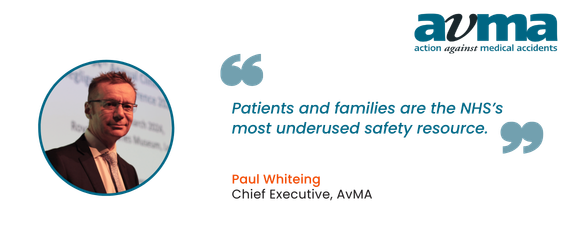
They are the NHS’s most underused safety resource.
The real question is not whether we value patient voice in principle, but whether we are curious enough to redesign our systems so we hear it — in time to prevent harm.
But — in the spirit of curiosity — what do you think?
———————————
AvMA is the only UK charity dedicated specifically to supporting people affected by avoidable medical harm.
We use what we learn from patients and families to influence policy and improve safety across healthcare systems and practice.
Our Harmed Patient Pathway work sets out what meaningful listening and learning after harm should look like.